

How India Became a Global Auto Manufacturing Hub
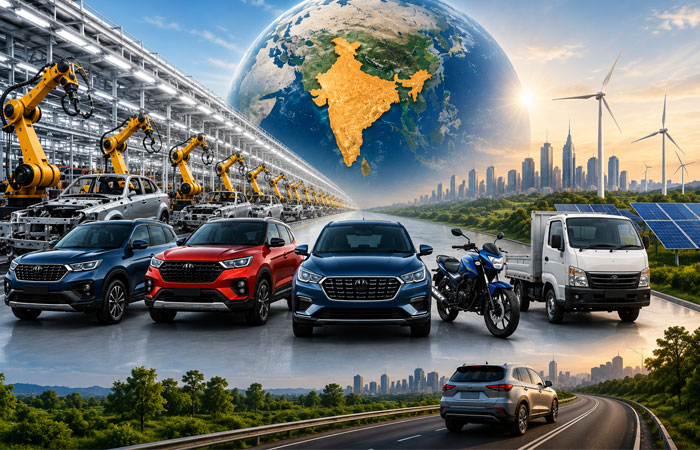
Three decades ago, India’s automobile industry was a closed, slow-moving system producing a handful of models for a captive domestic market. Today, the story reads very differently. The country now ships passenger vehicles to over a hundred countries, hosts plants for nearly every major OEM on earth, and is rapidly becoming a serious player in electric vehicle production. Behind this shift sit some of the top automotive companies in India — Maruti Suzuki, Tata Motors, Hyundai, Toyota, and Mahindra among them whose combined scale and ambition turned a once-protected domestic market into a genuine global manufacturing hub.
The Liberalization That Started It All
India’s story in automotive sector really begins in 1991, when the government de-licensed the auto sector and opened it to 100 percent foreign investment through the automatic route. Before this, the industry was tightly controlled, offering consumers a narrow set of choices built on outdated platforms. Liberalization changed that almost overnight, as global automakers entered through joint ventures with Indian companies and consumer choice expanded through the 1990s. Maruti Suzuki, which had arrived a decade earlier with government backing, became the breakout success of this era. By 2000, India had roughly a dozen major automotive players, most of them subsidiaries or joint ventures of global manufacturers, and the foundation for a modern industry was in place.
Building the Manufacturing Base
What followed was steady construction of an industrial ecosystem rather than a single growth spurt. Manufacturing consolidated into regional clusters that still define the industry today: Chennai grew into the largest hub by revenue, hosting Hyundai, Ford, and Renault-Nissan; the Pune-Aurangabad belt became home to Volkswagen, Skoda, and Mahindra; and the National Capital Region, anchored by Maruti Suzuki’s Haryana plants, formed the third cluster. This concentration let suppliers, testing facilities, and skilled labor cluster geographically, lowering costs nearby. India’s component sector now contributes 2.3% of GDP and employs over 1.5 million people directly, while the broader auto industry supports roughly 30 million jobs and nearly 7 percent of national GDP.
Policy as a Deliberate Growth Lever
If liberalization opened the door, policy kept the momentum going. The “Make in India” initiative, launched in 2014, signaled that the country intended to compete globally rather than just serve its own market, driving a decade of reforms, incentives, and infrastructure investment. More recent measures sharpened that focus: the Automotive Mission Plan and a vehicle scrappage policy aim to modernize the domestic fleet, while the Production-Linked Incentive scheme rewards manufacturers for scaling up domestic output and exports. The government doubled the PLI allocation to roughly Rs. 5,940 crores in the 2026-27 Union Budget, signaling that the scheme is entering a higher-growth phase.
The Numbers Behind the Hub Status
The scale India has reached shows up clearly in global rankings. The country is the largest manufacturer of three-wheelers in the world, among the top two manufacturers of two-wheelers, the top four manufacturer of passenger vehicles, and the top five manufacturer of commercial vehicles globally. In 2025, India became the world’s third-largest vehicle manufacturer overall. Exports tell a similarly strong story: between April 2025 and February 2026, India exported over 8.13 lakh passenger vehicles, up 19 percent year-on-year, with Maruti Suzuki holding 47.7 percent of that total and Hyundai close behind at 21.6 percent. Component exports reached roughly $21.2 billion in FY24 and are projected to climb toward $30 billion by 2026, with markets now spanning Latin America, Africa, Southeast Asia, and the Middle East.
The OEMs Leading the Shift
A handful of manufacturers are doing the heavy lifting. Maruti-Suzuki remains India’s largest producer by far, making around 2.25 million vehicles in 2025 and targeting nearly 4 million units of capacity by 2028-29. Tata Motors, boosted by its ownership of Jaguar Land Rover, opened a $1 billion EV-focused plant in Tamil Nadu in early 2026 with capacity for 250,000 vehicles annually. Toyota is expanding its Bengaluru operations toward 400,000 units, while Mahindra and Ashok Leyland have committed to major new facilities of their own, spanning both combustion and electric platforms.
The Next Frontier: Electric Vehicles
The next decade looks set to be about electrification. A CEEW Centre for Energy Finance study identified a $206 billion opportunity in India’s EV sector by 2030, requiring roughly $180 billion in investment. Maruti Suzuki has already begun exporting its first EV, the e-Vitara, to Europe, while government-backed infrastructure now includes over 14,000 e-buses and 9,300-plus public charging stations.
India’s path from a protected, low-choice market to a genuine global manufacturing hub wasn’t the result of any single policy or company. It was liberalization opening the door, regional clusters building real depth, sustained incentives keeping investment flowing, and ambitious manufacturers betting on combustion and electric platforms at once. Challenges around logistics and port capacity remain, but with India now competing against hubs like Thailand and Mexico in the sub-$20,000 segment, its rise looks less like an aspiration and more like a fact already taking shape.
About us:
ViewGates is a market research and business intelligence company that delivers reliable industry insights, market trends, and growth forecasts across global sectors. Our mission is to help businesses, investors, and decision-makers make informed strategic decisions through accurate, data-driven research and actionable market intelligence.