

Car and Bus Seats: More Than Just Comfort, It’s Safety
Article by - Vishwas Kale, Managing Director, Vijayesh Instruments Pvt Ltd
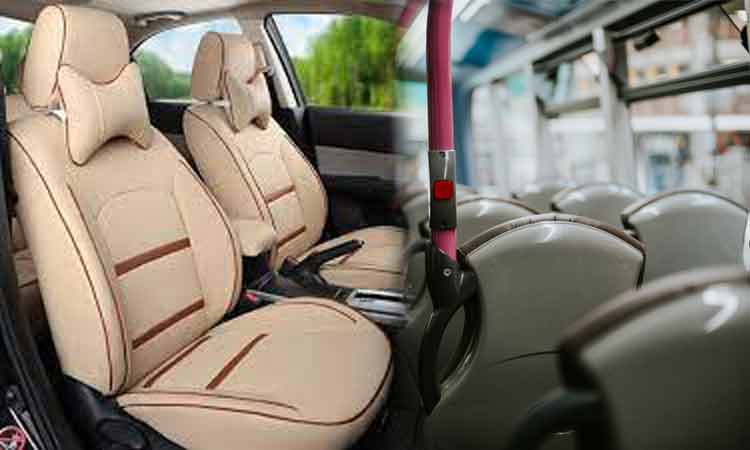
Car seats are composed of a metal frame for structural support, polyurethane foam for cushioning, and an outer trim cover made of fabric or faux leather for comfort and aesthetics. Additional components include mechanisms for adjusting height and lumbar support, headrests, and integrated safety features like airbags and pre-tensioners for seat belts. Polyurethane foam or Expanded polystyrene (EPP) is a common material, molded to the desired shape for the seat base and backrest. Other materials are Nylon, Leather, Polyester, Vinyl and faux.
Is car seat fireproof? No, not fireproof, but they are treated with flame retardants. These chemicals, while intended to slow the spread of fire, are a source of exposure to potentially harmful substances in vehicle cabin air, with some flame retardants linked to health risks like cancer. The goal of these chemicals is to make the material more resistant to fire and slow the rate of burning, not to make it completely unable to burn. These could be Halogenated (Chlorine or Bromine-Based, Phosphorus-Based, Organophosphate Esters (OP):
Research has shown that flame retardant chemicals are released from car seat materials and can be found in the air inside vehicles, leading to potential exposure for passengers. Some of these chemicals are known or suspected to be carcinogens (cancer-causing) and have been linked to other health issues, including impacts on the nervous and reproductive systems. Researchers and organizations are calling for these standards to be re-evaluated due to the health concerns associated with these chemicals.
In US, the flammability requirement for car seats was added to FMVSS 213 (Federal Motor Vehicle Safety Standard 213) in 1971. This requirement was introduced to improve the safety of car seats and reduce the risk of fires in the event of a car crash.
The addition of the flammability requirement aimed to ensure that car seats would not contribute to the spread of fires inside a vehicle, thereby enhancing overall safety for passengers.
To meet this requirement, many manufacturers incorporate chemicals known as flame retardants. However, not all manufacturers exclusively use these chemicals. Some have adopted naturally flame-resistant materials like wool to meet flammability standards. Wool’s inherent properties offer an effective, environmentally friendly alternative that eliminates the need for added chemicals. It is essential to recognize that flame retardants are not just limited to car seats. In fact, they are present in many parts of our vehicles, including the upholstery. Also they can be found in everyday items such as children’s clothing, mattresses, furniture, and carpets. While there is some evidence about significant health issues from exposure to these chemicals, the widespread use of flame retardants does raise questions about long-term effects. Today manufacturers are working to develop safer alternatives to offer flame retardant-free options for car seats.
In India, while there is no specific regulation mentioned about the flammability of car seats, a 2024 study in The Times of India found carcinogenic flame retardants in the cabin air and seat foam of cars, raising public health concerns for long-term exposure. These chemicals, like TDCIPP and TCEP, are linked to health risks including cancer, neurotoxicity, and reproductive issues. Though a specific flammability standard for car seats is not detailed, the widespread presence of these harmful chemicals is a significant concern, especially for children who are more vulnerable to their effects
What is IS 15061?
IS 15061 is an Indian standard, it applies to assess the burning behaviour (Ignitability, burning rate, melting behaviour) of interior materials used in motor vehicles of category M3 carrying more than 22 passengers. It is not yet applied for standing passengers and urban use (city buses).The latest version of IS 15061 is 2002, and it was reaffirmed in 2022.
In India, vehicles are categorized as Category A, C, L, M, N, T.
Where, Category M means a motor vehicle with at least four wheels used for carrying passengers.
- Category M1: Means a motor vehicle used for the carriage of passengers, comprising not more than 8 seats in addition to the driver’s seat.
- Category M2: Means a motor vehicle used for the carriage of passengers, comprising 9 or more seats in addition to the driver’s seat and having a maximum gross vehicle weight not exceeding 5 tons.
- Category M2G: Means a motor vehicle used for the carriage of passengers, comprising 9 or more seats in addition to the driver’s seat and having a maximum gross vehicle weight not exceeding 5 tons and additional off-road (cross country vehicle) capabilities.
- Category M3: Means a motor vehicle used for the carriage passengers, comprising 9 or more seats in addition to the driver’s seat and having a maximum gross vehicle weight exceeding 5 tons.
- Category M3G: Means a motor vehicle used for the carriage passengers, comprising 9 or more seats in addition to the driver’s seat and having a maximum Gross Vehicle Weight exceeding 5 tons and having additional off-road cross country vehicle) capabilities.
IS 15061defines 3 test methods to assess the material performance:
- Annex A, Test to determine the horizontal burning rate of materials. The limit is not more than 100mm/min
- Annex B, Test to determine the vertical burning rate of materials. The limit is not more than 100mm/min
- Annex C, Test to determine the melting behaviour of material. The criteria is no drops is formed which ignites the cotton wool
It corresponds to 3 test apparatuses to conduct 3 tests:
- Annex A, Flammability of Automotive Materials Tester
- Annex B, Vertical Flame Tester
- Annex C, Dripping Test Apparatus. This is generally very must in use.
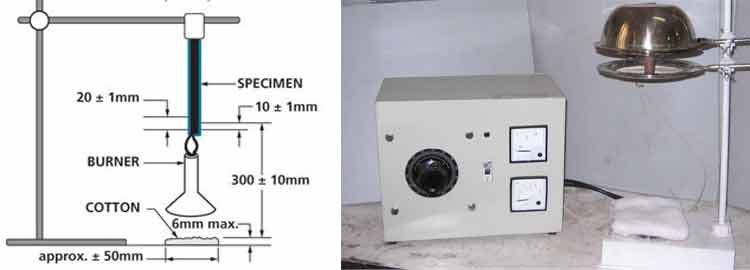
Today Annex C Test to Determine the Melting Behaviour of Materials is widely used e.g. at Tata Motors, ARAI, CIRT etc which is supplied by Vijayesh Instruments.
The unit consists of an electric radiator, support for the sample with grill, and a control unit. The source of heat is the electric radiator with specified output. The radiating surface is of transparent quartz plate. The heat radiates to the surface parallel to the radiator.
The samples are tested by putting under the heat, as per standard procedures. The unit is supplied with correct calibration.
Standards in India
Draft standards from the Ministry of Road Transport and Highways (MoRTH) cover components like frame structures (steel, aluminium, magnesium), foam padding for comfort, fabric or leather trim, and integral safety features such as headrests and integrated harnesses or anchor points for securing restraint systems. The ddevelopment is in progress. Indian standards, referred to as Automotive Industry Standards (AIS), are being drafted by industry panels.
More work is still being done by BIS to set standards to enhance safety in cars for seats, and interestingly it would apply to seats used anywhere in future.
Vishwas Kale is Managing Director, Vijayesh Instruments Pvt Ltd, Pune and has more than thirty years’ experience in instrumentation. He was twice President, International Society of Automation (ISA, USA) in India, now its Honourary Senior Life Member, Advisory Member of Committee of Bureau of Indian Standards (BIS), Member of Experts Panel of NCTS-Indian Institute of Foundrymen, among many positions he holds with various organizations. He has received awards for innovative products.
Author of two books:
- Instrumentation and Process Control Techniques in Foundries
- Management for Success