

India Strengthens Domestic Battery Manufacturing with ₹12,000 Crore Incentive Push
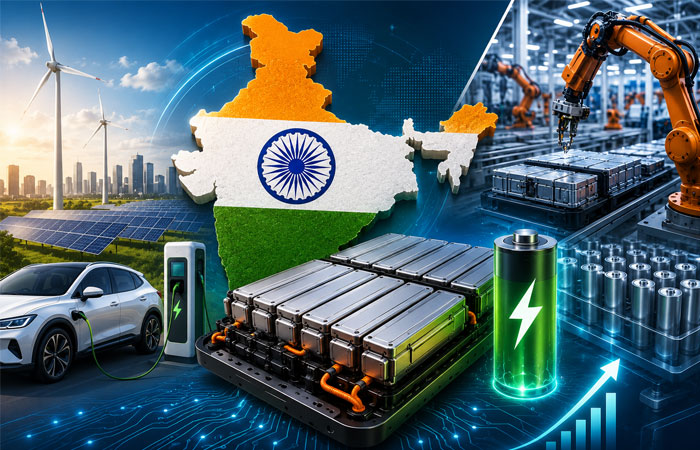
India is taking a significant step toward building a self-reliant battery manufacturing ecosystem by preparing a ₹12,000 crore incentive scheme to promote the domestic production of advanced battery components. The proposed initiative is aimed at reducing the country’s dependence on imported battery materials and strengthening the supply chain that supports electric vehicles (EVs), energy storage systems, and the broader clean mobility sector.
The government’s focus on domestic battery manufacturing is expected to accelerate growth for the top automotive battery companies in India, including Exide Industries, Amara Raja Energy & Mobility, Tata Green Batteries, Bosch India, Livguard Energy, and Okaya Power Group, as they expand production, invest in advanced battery technologies, and support the country’s growing automotive and electric vehicle markets.
Why the Initiative Matters
The demand for automotive batteries is increasing rapidly due to the growth of electric vehicles, hybrid vehicles, and advanced automotive electronics. Domestic manufacturing of battery components is expected to offer several long-term benefits, including:
- Reduced dependence on imported battery materials and components
- Stronger and more resilient domestic supply chains
- Lower production costs through localized manufacturing
- Increased investment in battery technology and innovation
- Job creation across manufacturing, research, and engineering sectors
- Enhanced competitiveness of India’s EV and automotive industries
Impact on the Automotive Battery Industry
The proposed incentive scheme is likely to accelerate investments by battery manufacturers and automotive suppliers looking to expand their operations in India. Companies producing automotive batteries may benefit from improved access to locally manufactured components, shorter supply chains, and reduced exposure to global supply disruptions.
The incentive program is expected to encourage investments in the manufacturing of critical battery components such as cathodes, anodes, separators, electrolytes, battery management systems, and other advanced materials. While India has made progress in assembling battery packs, much of the high-value battery component manufacturing still relies on imports, particularly from East Asian countries. Expanding local production will help improve supply chain resilience and support the government’s vision of establishing India as a global manufacturing hub for advanced battery technologies.
Supporting India’s EV Ecosystem
The initiative aligns with India’s broader clean mobility goals, including the expansion of electric vehicle adoption and the development of advanced energy storage technologies. By strengthening the domestic battery value chain, the government aims to create an integrated ecosystem that supports battery manufacturing, research and development, recycling, and innovation.
The policy also complements existing programs designed to encourage advanced chemistry cell (ACC) manufacturing and promote investments in sustainable energy technologies.
Future Outlook
India’s proposed ₹12,000 crore incentive scheme represents an important milestone in the country’s transition toward self-reliant battery manufacturing. As investments increase and local production capabilities expand, the initiative is expected to strengthen India’s position in the global battery supply chain while supporting the long-term growth of the automotive and electric mobility industries.
With rising vehicle production, increasing EV adoption, and continuous advancements in battery technology, domestic manufacturing is likely to become a key driver of innovation, sustainability, and economic growth in India’s automotive battery sector.