

How AI is Revolutionizing the Automotive Market: A Focus on the India Automotive Aftermarket Market
Article by 6W Research
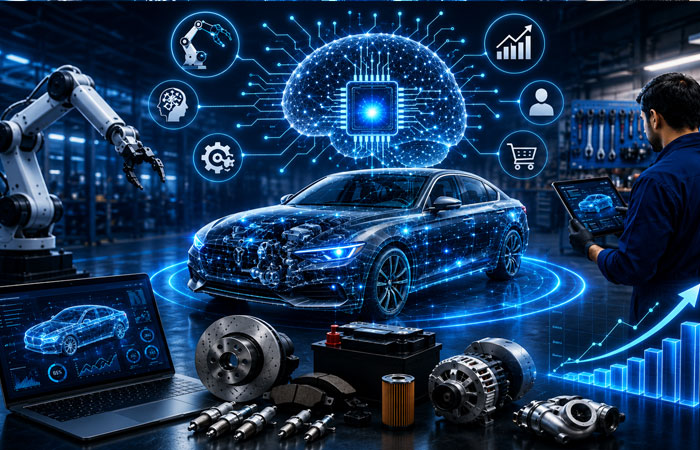
Artificial Intelligence (AI) is transforming the automotive industry at an unprecedented pace. From manufacturing and vehicle design to maintenance and customer service, AI is helping businesses improve efficiency, reduce costs, and deliver better experiences. As connected vehicles and electric mobility continue to gain momentum, AI is becoming a key driver of innovation across the automotive value chain. One area benefiting significantly from this technological shift is the India Automotive Aftermarket Market, where intelligent technologies are reshaping vehicle servicing, spare parts management, and repair operations.
AI is Reshaping Automotive Manufacturing
Automotive manufacturers are increasingly relying on AI to streamline production and improve quality. Modern factories generate massive amounts of operational data, and AI helps analyze this information to identify bottlenecks, optimize workflows, and reduce waste.
Computer vision systems inspect vehicle components with greater precision than manual methods, while AI-powered robots perform repetitive assembly tasks with speed and consistency. Predictive analytics also allows manufacturers to monitor equipment performance and schedule maintenance before machinery fails, reducing downtime and increasing productivity.
These innovations enable manufacturers to produce safer, more reliable vehicles while lowering operating costs.
Predictive Maintenance Is Changing Vehicle Servicing
One of AI’s most valuable applications in the automotive industry is predictive maintenance. Instead of relying on fixed service schedules, AI continuously analyzes data collected from sensors installed throughout the vehicle.
This technology can monitor:
- Engine performance
- Brake condition
- Battery health
- Tire pressure
- Cooling systems
- Transmission efficiency
When abnormal patterns are detected, the system alerts vehicle owners or service providers before a major failure occurs. Early intervention reduces repair costs, prevents unexpected breakdowns, and extends the lifespan of critical components.
For commercial fleet operators, predictive maintenance also minimizes downtime and improves operational efficiency.
Smarter Diagnostics Improve Repair Accuracy
Vehicle diagnostics have evolved significantly with the introduction of AI. Traditional troubleshooting often depends on manual inspections and technician experience, but AI-powered diagnostic tools can analyze thousands of data points within seconds.
These systems identify faults more accurately and recommend appropriate repair procedures. They can detect problems involving electrical systems, engines, transmissions, batteries, and onboard sensors before symptoms become severe.
As a result, workshops can complete repairs faster while improving service quality and customer satisfaction.
AI Is Accelerating Electric Vehicle Growth
Electric vehicles require advanced monitoring systems to ensure optimal performance and safety. AI plays a critical role in managing battery performance, thermal conditions, charging cycles, and energy consumption.
Modern Battery Management Systems (BMS) use machine learning algorithms to continuously evaluate battery health and optimize charging behaviour. This improves driving range, extends battery lifespan, and reduces the likelihood of unexpected failures.
AI also supports research into new battery materials, allowing manufacturers to develop higher-capacity batteries with faster charging capabilities and improved durability.
As electric mobility expands, service centres are adapting by investing in specialized diagnostic equipment and technician training to support next-generation vehicles.
AI Is Making Supply Chains More Efficient
Managing automotive components and spare parts is becoming increasingly complex as vehicle technologies evolve. AI helps manufacturers, distributors, and service providers forecast demand more accurately by analyzing historical sales, regional trends, seasonal demand, and vehicle usage patterns.
Smarter inventory management offers several benefits:
- Reduced stock shortages
- Lower inventory costs
- Faster order fulfillment
- Improved warehouse efficiency
- Better supply chain visibility
These improvements ensure that essential parts are available when needed while minimizing excess inventory.
Transforming Customer Experience
Customer expectations are changing rapidly, and AI is helping automotive businesses provide more personalized and convenient services.
Many companies now use AI-powered platforms to offer:
- Online service scheduling
- Digital maintenance records
- Automated service reminders
- Virtual customer support
- Personalized maintenance recommendations
- Real-time repair updates
These digital services reduce waiting times, improve communication, and create a smoother ownership experience.
AI Is Supporting Smarter Fleet Management
Fleet operators manage hundreds or even thousands of vehicles, making efficient maintenance essential for profitability. AI enables fleet managers to monitor vehicle performance continuously and identify opportunities to improve efficiency.
AI-powered fleet management systems analyze:
- Fuel consumption
- Driver behavior
- Vehicle health
- Route efficiency
- Maintenance requirements
These insights help businesses reduce operating expenses, improve safety, and maximize vehicle availability.
Sustainability Through Artificial Intelligence
Sustainability has become a major focus across the automotive industry. AI contributes by helping manufacturers optimize production processes, reduce material waste, and improve energy efficiency.
AI also supports recycling initiatives by identifying reusable materials from vehicle components and improving the sorting of recyclable parts. In addition, intelligent manufacturing systems minimize energy consumption while maintaining consistent product quality.
As companies work toward lower carbon emissions, AI will continue to play an important role in building a more sustainable automotive ecosystem.
Challenges to AI Adoption
Although AI offers significant benefits, its implementation is not without challenges.
High Initial Investment
Advanced AI software, connected equipment, and automation technologies require substantial investment, particularly for smaller businesses.
Workforce Development
The industry needs skilled professionals who understand artificial intelligence, data analytics, robotics, and modern vehicle technologies. Continuous training is essential as vehicles become increasingly software-driven.
Cybersecurity
Connected vehicles and digital manufacturing systems generate vast amounts of data. Protecting this information from cyber threats is becoming a top priority for automotive companies.
Technology Integration
Many organizations still operate legacy systems that are difficult to integrate with modern AI platforms. Successful digital transformation requires careful planning and long-term investment.
The Future of AI in the Automotive Industry
Artificial Intelligence will continue to shape the future of mobility over the coming decade. Emerging technologies such as digital twins, edge computing, autonomous systems, and generative AI will further improve manufacturing efficiency, vehicle safety, and maintenance capabilities.
Connected vehicles will generate even larger volumes of real-time data, enabling more accurate diagnostics and predictive maintenance. Workshops will increasingly rely on AI-powered tools to identify faults, recommend repairs, and manage inventory more efficiently.
At the same time, electric vehicles will drive demand for specialized servicing, battery monitoring, and software-based maintenance solutions. Companies that embrace AI early will be better positioned to adapt to evolving customer expectations and technological advancements.
Conclusion
Artificial Intelligence is no longer an emerging technology—it has become a fundamental part of the automotive industry’s transformation. From intelligent manufacturing and predictive maintenance to advanced diagnostics and smarter supply chains, AI is improving efficiency across every stage of the vehicle lifecycle.
As the industry continues its transition toward connected and electric mobility, businesses that invest in AI-driven innovation will gain a competitive advantage through better operational performance, improved customer experiences, and more sustainable practices. The combination of intelligent technologies, digital infrastructure, and data-driven decision-making will define the next generation of automotive services, creating a more efficient, reliable, and future-ready mobility ecosystem.