

The Green Revolution 2.0: How EV Tractors Are Driving Sustainable and Low-Emission Agriculture

The first Green Revolution transformed Indian agriculture by introducing high-yielding crop varieties, irrigation systems, fertilisers, and mechanisation. It enabled the country to become self-sufficient in food production and laid the foundation for modern farming. Today, agriculture faces a new set of challenges: climate change, rising input costs, resource scarcity, and the need to reduce carbon emissions. Addressing these issues requires a new wave of innovation, often referred to as the “Green Revolution 2.0.“
At the heart of this transformation are technologies that improve productivity while minimising environmental impact. Among them, electric (EV) tractors are emerging as a powerful tool for creating a more sustainable, efficient, and low-emission agricultural sector.
Rethinking Farm Mechanisation
Diesel tractors have been indispensable to Indian agriculture for decades. However, their dependence on fossil fuels contributes to greenhouse gas emissions, air pollution, and rising operating costs.
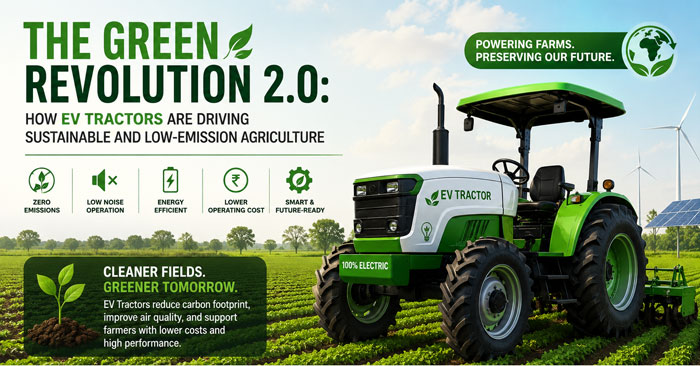
Electric tractors offer a cleaner alternative. Powered by rechargeable batteries, they operate without tailpipe emissions and require significantly less maintenance than conventional diesel machines. As battery technology continues to improve, EV tractors are becoming increasingly capable of performing a wide range of agricultural tasks while reducing environmental impact.
This shift represents a fundamental change in how mechanisation supports sustainable farming.
Lower Emissions, Healthier Farms
Agriculture plays an important role in India’s climate commitments. Reducing emissions from farm machinery can contribute meaningfully to creating cleaner rural environments and more sustainable food production systems.
Electric tractors eliminate exhaust emissions during operation, improving air quality for farmers and nearby communities. When powered by renewable energy sources such as solar electricity, they further reduce agriculture’s dependence on fossil fuels.
Cleaner machinery also aligns with the growing demand from consumers, food processors, and export markets for sustainably produced agricultural products.
Economic Sustainability Matters Too
Environmental sustainability alone is not enough; technologies must also improve farm economics. Electric tractors help farmers reduce recurring expenses by replacing diesel with electricity, which is generally less expensive and more stable in price.
Maintenance costs are also considerably lower because electric drivetrains have fewer moving components and do not require engine oil changes, fuel filter replacements, or extensive mechanical servicing.
Over the lifetime of the tractor, these savings improve profitability, making sustainability financially viable rather than merely environmentally desirable.
Integrating Renewable Energy
One of the most promising aspects of EV tractors is their compatibility with renewable energy. Many Indian farmers are already adopting solar-powered irrigation systems, creating opportunities to use the same infrastructure for charging electric farm equipment.
This integration allows farms to generate clean energy on-site, reducing dependence on diesel while improving energy security. Combined with battery-powered machinery, solar energy creates a self-sufficient agricultural ecosystem capable of supporting long-term sustainable growth.
Such models will become increasingly valuable as energy prices fluctuate and climate resilience becomes a higher priority.
Smarter Farming Through Technology
Electric tractors are also helping modernise agriculture through digital innovation. Many models incorporate GPS guidance, telematics, battery management systems, remote diagnostics, and precision farming capabilities.
These technologies enable farmers to optimise field operations, monitor equipment performance, reduce resource wastage, and improve decision-making. Better efficiency translates into higher productivity while minimising environmental impact.
The integration of clean energy with precision agriculture is likely to define the next generation of mechanised farming.
The Road Ahead
Challenges remain, including higher upfront costs, evolving charging infrastructure, and battery limitations for prolonged heavy-duty operations. However, rapid advancements in battery technology, increasing domestic manufacturing, and supportive government initiatives are steadily addressing these barriers.
The transition from diesel to electric tractors will happen progressively rather than overnight. Yet the momentum is unmistakable. As farmers seek solutions that improve profitability while reducing emissions, EV tractors are becoming an increasingly practical investment.
The Green Revolution 2.0 will not be driven solely by higher yields—it will be powered by technologies that balance economic growth with environmental stewardship. Electric tractors embody this vision by combining cleaner energy, lower operating costs, and smarter farming practices. As adoption accelerates, they are poised to play a central role in building a resilient, productive, and low-emission future for Indian agriculture.